
The Interface: Cognichip Blog
Is AI Going To Take All Our Jobs?
May 23, 2025
By: Simon Sabato
Co-founder & Chief Architect, Cognichip
It's the question I get asked most often: "Is AI going to take all our jobs?" As someone who has spent decades designing chips and now leads a company building AI for chip design, I have a perspective that might surprise you.
A Picture Is Worth a Thousand Transistors
To understand where we're going, we need to understand where we've been. Let me take you back to 1994—the year I designed my first chip.
Back then, chip design was an intensely manual craft. We drew schematics by hand, placed transistors individually, and verified functionality through painstaking simulation. A small design might take a year. A complex one, several years.
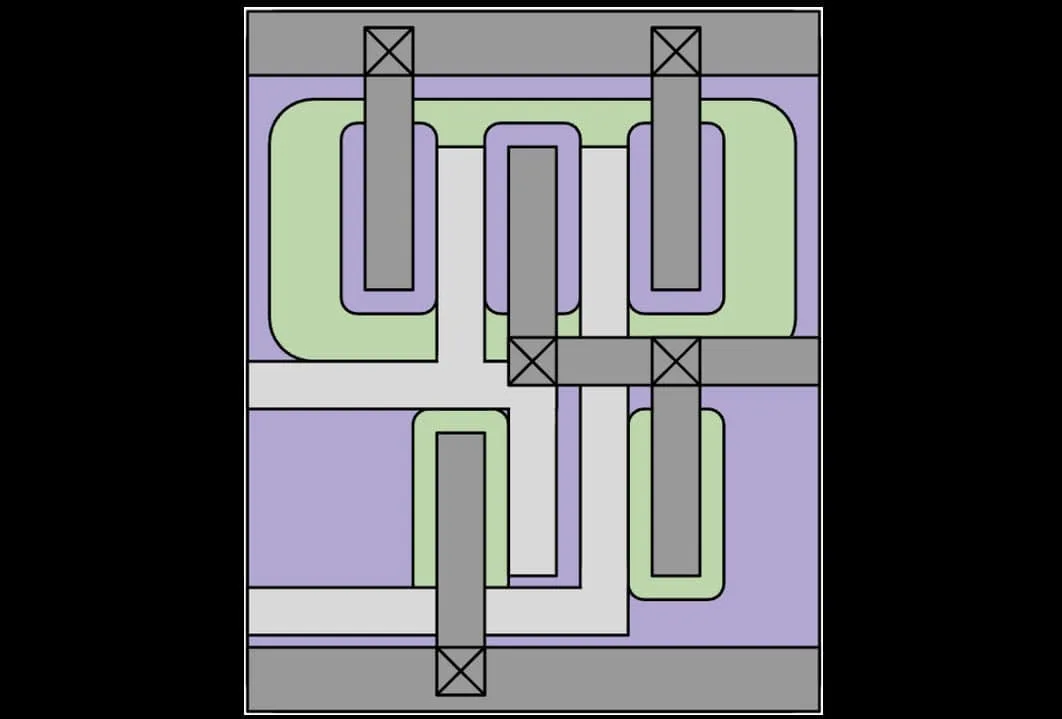
Above is a simple gate with four transistors. On paper, the wires appear ~5mm wide, in different colors for different "layers"—a modern chip would have ~15 such layers. These wires are what we're talking about when we say that a new phone has a "5nm chip." Which tells us that our picture is drawn at 1,000,000:1 scale (5mm : 5nm). A typical CPU chip will be around 12x12mm, so drawn at the same scale, it would be a 12x12km field of gates.
1994: The Synthesis Revolution
Then came logic synthesis—a technology that automatically converted high-level descriptions into optimized gate-level implementations. Many predicted it would eliminate chip design jobs.
The opposite happened. Synthesis didn't replace designers—it elevated them. Freed from tedious gate-level work, engineers could focus on architecture, optimization, and innovation. The industry didn't shrink; it exploded.
My first FPGA design cost around $100K to develop—even though I did the entire design myself. My first ASIC was 50K gates and required a team. Today's chips have billions of gates, and the industry employs 338,000 people while supporting 300 downstream economic sectors employing over 26 million U.S. workers.
Modern Chips: A Fast Machine
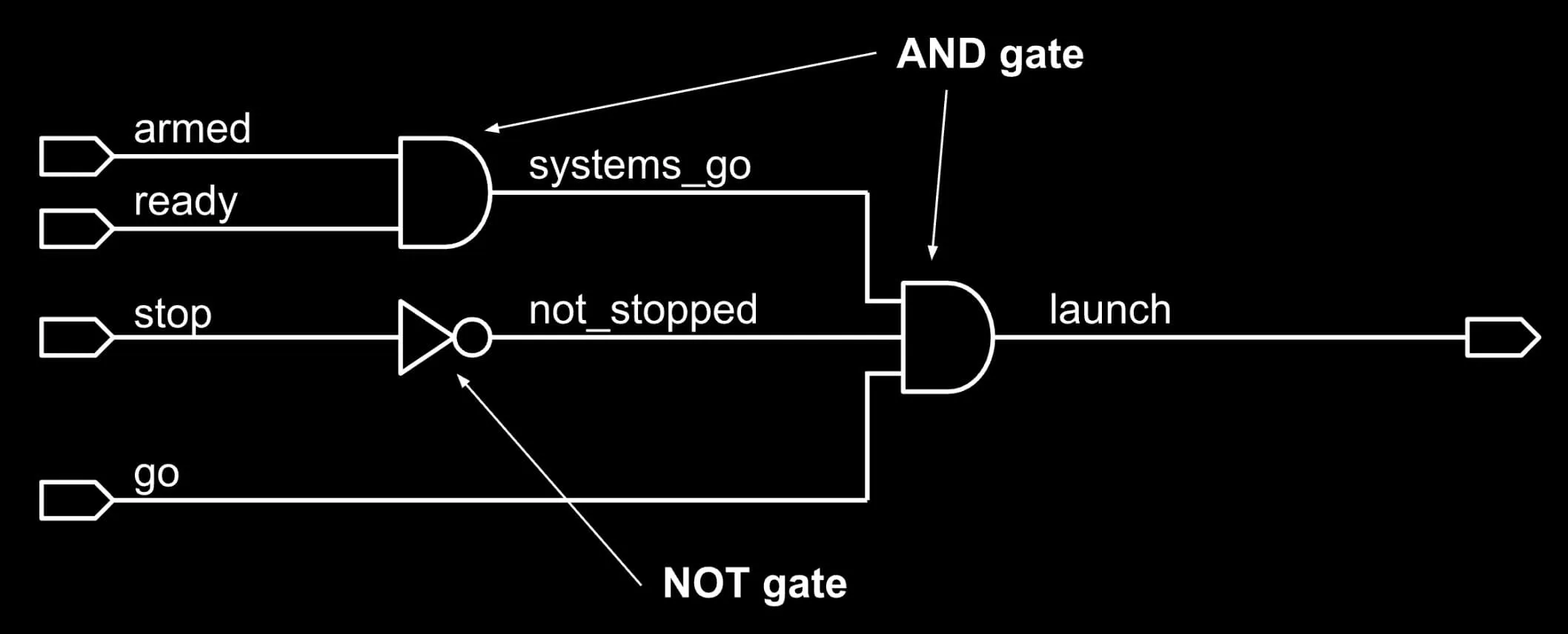
To get a sense for how fast these chips can crunch numbers, consider this. In 2025, our phones typically have 6 CPU cores, each executing ~4 instructions per 2.5GHz clock, which means they're churning through 60 instructions per nanosecond. That is a billionth of a second, less time than it takes photons moving at the speed of light to travel from our phone to our face.
A chip is a fast machine.
Looking at chips today, it's hard to imagine how they could have been designed without the revolutionary technology of logic synthesis. To be honest, synthesis did take away most jobs involving schematic-level design jobs: it did them better and faster, enabling us to focus on designing larger, more feature-rich chips.
In Dire Need of a New 'Synthesis' Moment
Despite impressive growth and innovation, the semiconductor industry is facing another inflection point. Design costs are too high, and still rising. Schedules are too long, and still increasing. Job market data, meanwhile, is predicting a massive shortfall in the number of engineers coming into the profession.
There have been many attempts to find the next leap forward in chip design productivity:
- Register-Transfer Level (RTL) design is dominated by SystemVerilog, but there is also VHDL, as well as a handful of smaller "modern" languages, that all operate fundamentally at "the same level"—i.e. one could write a program to translate between them fairly easily.
- High Level Synthesis tools take a variety of input languages (C/C++, Python, etc) and "unroll" the code, typically translating into SystemVerilog. This methodology has its adherents and its successes, but the reality is that most major chips are not designed this way.
It is now time to move to a higher level of abstraction in design, a new 'synthesis' moment if you will. Recent advancements in AI are inviting us to consider if natural language could be our next "higher-level language." Like last time, this will quickly go from something casually mentioned by a colleague, to staring us in the face with results we have trouble believing.
So … Is AI Going to Take All Our Jobs?
Thinking back to the early synthesis days, I can now confidently answer: no, it won't.
Without synthesis tools, it's true that we would need much larger teams to create today's chips, but it's also true that the chip market would be much smaller—fewer products, at higher cost, and lower performance. The vast majority of chip design jobs would be monotonous, repetitive, and lower paying.
Would chip designers have preferred to be crafting gate-level designs to this day, versus synthesizing the amazing chips that defined the 21st century? No, they wouldn't. Synthesis tools propelled an industry that has multiplied many times in revenue since 1990.
For similar reasons, I expect that AI-enhanced chip design will increase the number of jobs and make them more interesting. Soon, more chips will be designed, each more precisely targeted to its application, with more features, all at lower cost and power. AI models will enable us to build more of the chips we want, instead of just the chips we can.
By: Simon Sabato
Co-founder & Chief Architect, Cognichip


